NACS CSE: Copenhagen sets the stage for the future of convenience
Published on: May 28, 2025
NACS Convenience Summit Europe, held in Denmark's capital, brought together the continent’s top retail minds to exchange ideas, tour innovative stores, and honor innovation in the field. With food, technology, and EV charging at the forefront, Copenhagen proved a fitting showcase for where convenience retail is heading.

Set against the dynamic backdrop of Copenhagen, the 2025 NACS Convenience Summit Europe brought together over 150 senior leaders from over 20 countries for three days of knowledge and networking. From engaging presentations to fascinating tours, the summit delivered a panoramic view of where European convenience retail is heading and explored some of the biggest global challenges.
A sector in transition
The summit opened with a data-driven overview of Europe’s retail landscape, presented by Vincent Cornu of NielsenIQ. His findings underscored both the resilience and fragility of the market. Total convenience sales across Europe reached €90 billion, up 0.4% year-over-year. But beneath that modest rise, volume sold was still down, especially in staples and non-alcoholic beverages. The region is in a post-inflation hangover: while prices have stabilized, consumer confidence remains fragile, and shoppers are still trading down, delaying purchases, or shifting channels.
Importantly, discounters are gaining serious ground. In 2024 alone, hard discount stores opened more than 2,500 new locations across Europe, dwarfing the expansion rate of supermarkets and convenience stores combined. C-stores can put up a fight by focusing on experience, quality, and convenience.
Innovation on the ground
The “Ideas 2 Go” program showcased Copenhagen as a living lab of retail diversity. Quality food, advanced technology, and e-mobility are three areas where the Danish thrive. Standouts included 7-Eleven’s polished stores, including the highest-grossing 7-Eleven in the world, Circle K’s combination of food and tech, and the innovative collaboration between Q8 and Noah’s.
Retailers like Netto (a discount staple) and Spar blended grocery functionality with visual freshness and clever merchandising. The Tivoli Foodhall, Supermarco, and Mad & Vin clearly showed the passion that Danes have for quality food options.
Retailers rise to the occasion
Several case studies and executive presentations brought the role of retailers into focus. Hans-Olav Høidahl, EVP at Circle K Europe, laid out a clear strategy centered on four “lighthouses”: foodservice excellence, loyalty-driven digital engagement, supply chain discipline, and a massive push into e-mobility. Since 2023, the company has expanded through its acquisition of 2,193 assets from TotalEnergies in Germany and the Benelux, propelling its European market reach from 70 million to 185 million people.
Reitan’s Jesper Østergaard highlighted how 7-Eleven Denmark is leveraging its local roots with an agile product development process. Each store sells an average of 600 food and bakery products per day, reaching approximately 900 customers. These figures and the efficiency of the business explain why the three best-selling 7-Eleven stores in the world are in Denmark.
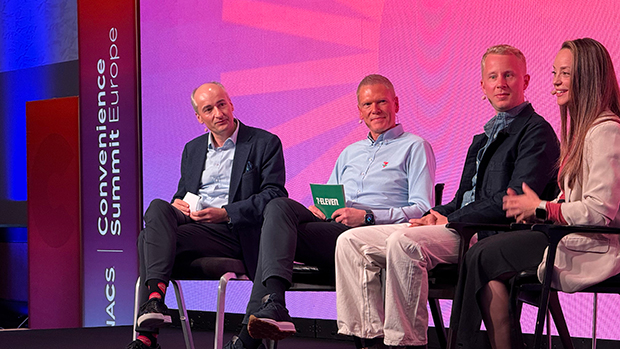
Maite de la Arena (YPF) offered a view into how even in economically turbulent markets, convenience can be a lever for differentiation and profitability. Strong customer insight and operational excellence have helped YPF transform its Argentinian stations, including the famous Alcorta site in Buenos Aires.
In the Gulf region, Trolley's presents a sleek, hospitality-centered retail model that combines Scandinavian aesthetic cues with local market sensibilities. With stores located in high-traffic transit hubs and malls, Trolley’s model leans into design and tech without sacrificing speed or service.
Tech meets strategy
Tech-focused sessions brought structure and pragmatism to the digital conversation. Brian Gray of Accenture challenged attendees to “get beyond the AI hype,” urging them to pursue use cases with real ROI. He discussed how AI-powered solutions like hyperlocal demand forecasting, predictive inventory management, and customer churn modeling, all designed to unlock margins without increasing operational complexity.
James Tasnadi of Lockton offered a darker but important message. With ransomware threats increasing, especially in the retail and payments ecosystem, cyber preparedness is now a board-level topic. The cost of cybercrime is now valued at a whopping $10.5 trillion. Tasnadi noted that over 70% of cyberattacks in retail begin with phishing, and that “double extortion” ransomware, where attackers steal and encrypt data, has become standard. His playbook for resilience included staff training, endpoint visibility, and third-party insurance coverage.
On the mobility front, Oliver Wyman’s Héloïse de Paulou Massat dissected EV charging behavior. Contrary to conventional belief, EV drivers aren’t just “charging and leaving,” they seek dwell-time value. 30% of EV charging customers are open to making in-store purchases if the experience is frictionless and curated, making it a critical upsell opportunity.
Don't forget Gen X
Virginia Garavaglia (NIQ) argued that Generation X, often ignored in favor of millennials and Gen Z, currently leads global consumer spending ($15.2 trillion) and will continue to do so for at least the next decade. Gen Xers crave consistency, loyalty rewards, and functional convenience, which are often overlooked in experience-driven innovation agendas.

Celebrating convenience excellence
NACS recognized three standout retailers for their forward-thinking approaches to convenience retailing. Swiss-based Avec Freiestrasse, operated by Valora, earned the prestigious Convenience Retailer of the Year Europe award. The store was celebrated for its seamless blend of manned and autonomous operations, anchored by “The Kitchen,” a digitally enhanced food concept. On Sundays, the location transforms into a fully autonomous 24/7 store, accessible and operable via the avec app.
Reitan Convenience received the Sustainability Award, acknowledging its bold overhaul of food-to-go offerings by shifting away from red meat. In 2024, Reitan replaced its top-selling beef sausages with chicken-based options, achieving a 9-point drop in red meat share, in line with its commitment to integrate sustainability across its whole operation.
The Technology Award went to Circle K, which impressed with its use of AI to streamline recruitment across its 5,200 European locations. By automating candidate evaluation and integrating predictive analytics, the company is reducing turnover and enhancing operational efficiency.
Mariette Kristenson, CEO of Reitan Convenience Group, was honored as Industry Leader of the Year, highlighting her long-standing leadership across Sweden and broader European operations.
The road ahead
Whether it’s reimagining fuel retail, embracing AI, or segmenting loyalty programs by generation, the retailers poised to thrive are those who balance technological ambition with a strong understanding of their customers.
Next year, NACS Convenience Summit Europe will take place June 2-6 in Warsaw, Poland.