The Multi-Energy Race
Published on: Apr 15, 2026
Advertorial
Why do service stations lose revenue long before a real breakdown occurs? Discover how multi-energy complexity impacts uptime, customer experience, and profitability.

It is 7:12 a.m. The morning rush is already underway. A delivery van pulls up to pump 3, a commuter quickly fills up with gasoline, and on the other side an electric car is waiting at the charging point. Inside the shop, someone grabs a coffee for the road. From the outside, it looks like a perfectly normal morning at a modern service station.
But in the background, it is precisely in moments like these that the decision is made whether a site is generating revenue or losing potential.
Because the service station has changed. What used to be a traditional forecourt has become a multi-energy site. Diesel, gasoline, gas, electricity, and other forms of energy all have to work in parallel. For customers, however, the expectation remains exactly the same: arrive, refuel or recharge, pay, and continue the journey. Quickly, easily, seamlessly.
The customer does not think in terms of energy carriers. The customer thinks in minutes.
That is exactly why the multi-energy race is not won by the number of fuels on offer. What matters is whether every single fueling or charging point is reliably available. Because only an available energy point can generate revenue.



When small issues become a business problem
That sounds obvious. In practice, however, losses often begin long before an actual failure becomes visible.
A classic example: the flow rate at a fuel pump gradually declines. The system is still functioning, so the issue is easily overlooked in day-to-day operations. But suddenly the refueling process takes longer. A vehicle blocks the fueling point for several minutes longer than necessary. During that time, fewer additional customers can be served. Throughput drops. Revenue does too.
What may look like a minor technical issue is highly relevant from a business perspective.
Because the longer a customer occupies the fueling point, the fewer vehicles can refuel in the same amount of time. This is exactly where it becomes clear how closely technology, customer experience, and profitability are connected today. Multi-energy does not simply mean a broader offering. Multi-energy also means greater operational complexity.
More forms of energy bring more technology, more interfaces, more maintenance requirements, and more potential sources of error. At the same time, many operators are under intense pressure: faults need to be resolved faster, maintenance must be managed properly, service providers coordinated reliably, and compliance checks documented without gaps. And all of this ideally without creating additional administrative effort.
This is exactly the point where technology becomes a management issue.
Because today, the key question is no longer just: Which energy types does my site offer? It is: How do I ensure that this infrastructure also performs economically?

How omis helps operators stay ahead
Many problems only become visible once they have already become expensive. When a fueling point is out of service. When the service provider’s response time is not met. When inspection certificates are missing. When certain sites generate an unusual number of faults. Or when it becomes apparent too late that maintenance would have made more sense earlier than dealing with a breakdown.
That is exactly where omis comes in.
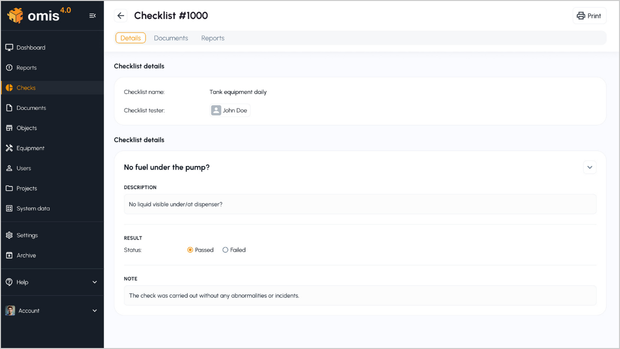
omis helps service station operators identify technical irregularities at an early stage, manage maintenance and service processes in a structured way, and actively improve the availability of their assets. Instead of only taking action once a defect has already occurred, omis creates transparency around conditions, processes, and required actions. This allows measures to be initiated earlier, failures to be avoided, and downtime to be shortened.
This is not only an advantage for the technology, but above all for the business. Because a smooth refueling or charging process means faster handling, less frustration for customers, and greater revenue potential per fueling point.
As a cloud-based maintenance software solution for the retail and forecourt sector, omis helps digitize service processes and automate asset management. According to the company, this can increase asset availability by up to 30 percent, reduce life cycle costs by up to 20 percent, and lower administrative costs by up to 25 percent.
This lever is becoming increasingly important, especially in the multi-energy environment. Because the more diverse the site, the more valuable a system becomes that maintains oversight, detects changes early, and derives concrete actions from them.
Anyone who already notices that faults are identified too late, processes are still unnecessarily manual, or revenue is being lost due to gradual performance decline should not wait for the next real failure.
The race has already begun
The multi-energy race has long since begun.
The only question is whether your processes are already keeping pace.
A conversation with omis will quickly and without obligation show you where availability is being lost at your site, where processes are being slowed down, and how you can get more out of your infrastructure. That is where the decisive competitive edge lies today. Are you interested in a pilot project with 5 to 10 service stations? Then feel free to contact omis for a non-binding conversation.