Driving the future of energy: Insights from MADIC Group's founder
Published on: Dec 3, 2024
Advertorial
Only a few industrial companies develop their expertise internationally while maintaining a sustainable development strategy. MADIC group is one of them! Meeting with Christian Blossier, Founder and Chairman of the family MADIC group which innovates on three fronts: automotive energies, unattended payments and digital systems.
What is the growth potential for HVO?
HVO, based on mineral and vegetable oils and used fats, is a product classified in the biodiesel family. It can practically replace traditional diesel fuel. Having recently arrived on the market, this low CO2 emission product should experience rapid growth, whilst initially limited technically by production capacities and then tempered by high production costs. To help the energy transition, reduced taxation could encourage the development of this product, particularly in businesses, with the target of medium-heavy transport.
How is e-mobility progressing across global markets?
Globally, almost all electric mobility is currently spread across three geographic areas: China, Europe and the United States, with the rest of the world seemingly not yet too concerned about the decarbonization objectives of road transport. In the three previously listed areas progression was strong and EV registrations compared to total registrations represented approximately 30%, 25% and 20% respectively, i.e. nearly 14 million EVs sold in 2023 compared to 11 million in 2022 and 7 million in 2021.
In 2024, a dichotomy between the European political will for all-electric and the reality of the market led to the start of a serious crisis in the automotive industry caused by a slowdown in EV sales without compensation for sales of internal combustion vehicles. This slowdown in EVs is attributed to a reduction in tax relief, the slow deployment of intercity fueling networks and somewhat long charging times. There is no doubt that the future will see these last two obstacles fade away, but in the meantime, and during this transition period, hybrid technology should dominate electric mobility.
How quickly will LNG and CNG shift towards bio alternatives?
Supported by state aid for the decarbonization of mobility, the evolution of the biogas fleet in France is occurring at a sustained pace on the existing infrastructure of the current network.



Will hydrogen play a larger role in the transportation ecosystem?
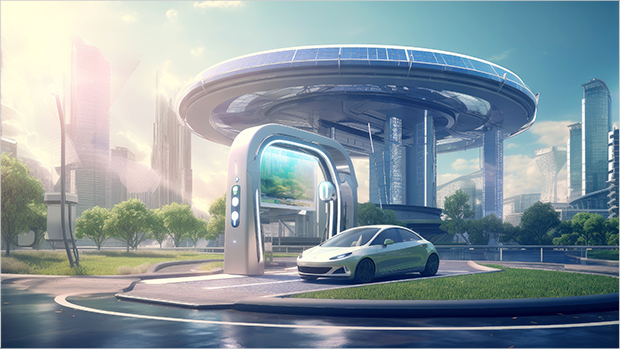
Hydrogen is expected to become the 2nd source of electromobility since it powers an on-board fuel cell. Unlike electricity, it can be stored, transported and distributed like any liquid or gas product. Its major drawback is, for the moment, its production method, which is both costly and energy-intensive.
But we believe that in the future hydrogen will be a very interesting solution for mobility when its production has become more ecological (green hydrogen). Indeed, in addition to their zero emissions in the form of water vapor, hydrogen vehicles will benefit from a weight ratio of onboard energy to autonomy similar to that of fossil fuel. Vehicles will no longer carry two-thirds of their weight in batteries, and this technological economy will have many advantages including less dependence on rare minerals for manufacturers, less damage due to less weight on the environment, probably better residual values on vehicles etc.
The next few years will undoubtedly see the arrival of comparative assessments of energy costs on production/transport/use of electricity and hydrogen. Political will and the market could then be the driving force to kick-start automobile manufacturers and infrastructure investors.
Do synthetic fuels have a future in road transportation?
It is regrettable that the European Commission decided to stop the internal combustion engine rather than stopping CO2 emission engines by 2035. This would have avoided certain countries being forced to exempt themselves from the agreement under the pretext of zero-emission synthetic fuels, which in fact was the original aim.
E-fuels therefore certainly have a good place to play in the field of mobility. They have the double advantage of retaining all the performance of fossil fuels in terms of on-board weight to autonomy ratios, and of taking advantage of the existing and incredibly dense distribution network.
However, the three main obstacles to their development will undoubtedly be:
- Their production considerations in terms of price and energy.
- Their production capacity in response to demand levels.
- The consequent and irreversible modifications to refineries in the wake of political decisions which are likely to change.
The evolution of technology will determine the proportion of these fuels in the multi-energy sphere of tomorrow.
Will it be more profitable for retailers to focus on energy-specific fuel stations or to adopt a multi-energy model?
Given the existing vehicle fleet, petrol stations still have a bright future and tomorrow will be distributors of liquid, fossil and synthetic fuels. Therefore, this network will retain most of its coverage, its capacities, its maintenance and its profitability.
The situation is different for new public distribution networks for alternative energies, notably electricity and hydrogen, for which investments are heavy and the vehicle park is still too small.
Our vision for the future is that in the next 30 years, no energy will have the same monopoly that fossil fuel has had for a century. The automobile park will be made up of all the energies that we know to date, before a more restricted offering is dictated by politics, technology, the automobile manufacturers, but also the market!
For investor-distributors, where they have the possibility, the best option seems to be on the multi-energy side.
It is also the choice of our MADIC Group and our development strategy is to cover multi-energies for mobility, their unsupervised payment systems and their data management systems.