How the rising EV adoption is transforming forecourts – and can benefit them
Published on: Dec 8, 2023
Advertorial
The world is moving towards a multi-energy approach on mobility, and the adoption of electric vehicles by consumers and fleets plays an important role in supporting the reduction of CO2 emissions. Service stations are on the forefront of the energy transition, with several opportunities to evolve to comprehensive mobility hubs. In this article, TSG, as an enabler of this transformation, explains options and possibilities for service stations.
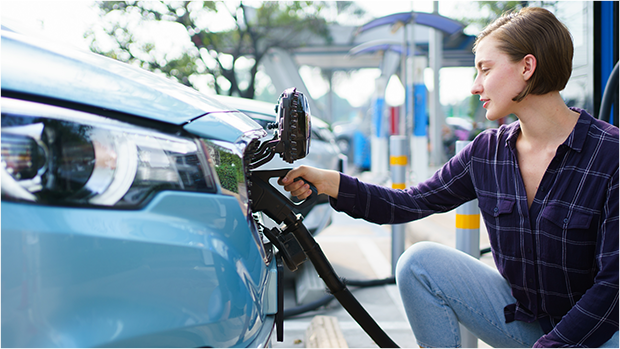
In the first eight months of 2023, one million fully electric vehicles (EVs) were sold in the European Union (EU). At the beginning of November that year, Europe also reached the milestone of 600,000 charging points, just a few months after reaching 500,000 EV charging points. The figures show that 2023 will be another relevant year for the European EV market.
The transport sector is moving in the direction of greener, multi-energy mobility. This is consequently changing driving habits with the gradual introduction of electric vehicles, which are 4.4 times more efficient in using energy than internal combustion engine vehicles (ICEs) to move the same payload. EVs are also becoming cheaper for consumers, thanks to support mechanisms on the way to cost parity.
One of these mechanisms is the Fit for 55 plan, a regulatory incentive from the European Union to support the shift to a future with diverse energy options. The Fit for 55 is accelerating the technological development and making manufacturers prioritise carbon-neutral vehicle options, thereby promoting more sustainable mobility.
With car production becoming more competitive, EV prices tend to get more accessible. However, popularisation is intensifying the main challenge facing these vehicles: infrastructure. EV sales are soaring, and are forecast to continue to do so. Nonetheless, drivers need to be able to finish their journeys with enough battery in the car, even on long journeys – overcoming the so-called ‘range anxiety’ barrier.


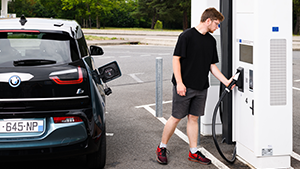
In response to that, incentives and regulations encourage manufacturers to produce better electric vehicles, and higher technology allows them to improve batteries quality and lifespan. The Fit for 55 programme also addresses the need for development with the Alternative Fuels Infrastructure Regulation (AFIR). It stipulates that all major motorways in the EU must have fast-charging stations every 60 km with a minimum capacity of 150 kW for cars and 350 kW for trucks. It sets out further requirements, such as a simpler and more transparent process for paying for the energy used to charge vehicles.
The impact of EVs on traditional service stations
With more EVs on the road, refuelling activities are changing. Between 50% and 80% of consumers’ charging takes place at home, while 15%-25% occurs at the workplace. Public locations account for 10%-15% of all charging events, depending on the European region. This share also includes a wide range of businesses, such as ‘destination charging’ locations – supermarkets, public car parks in cities, partially dedicated charging hubs from new Charging Point Operators (CPOs) and traditional forecourts. All of them evolving their business models to meet new demands and latest driver expectations.
‘The more fast-charging points there are, the more drivers tend to use them to charge their EVs, especially if the fast-charging experience offers a reasonable price for electricity and a good side experience with additional services and facilities. Moreover, we see an increasing trend to charge at public fast-charging on the most mature EV countries. In Norway and Denmark, recharging occurs at public hubs over 20% of the times. This reinforces the long-term attractiveness of the segment,’ says François Parniere, Group EV Director at TSG.
Some service stations are already moving towards becoming mobility hubs, incorporating new services. ‘Service stations can leverage the demand for EV charging outside private spaces and include valuable adjacent services for their customers, leading the change in the sector and maintaining their relevance in a competitive market,’ Parniere adds. ‘They have the advantage of strategic locations, which are convenient spots for heavy traffic. By becoming multi-service, they can be potential destinations for EV drivers and increase their retail revenues, as EV drivers stay at a forecourt about 3 to 4 times longer than ICE drivers,’ he adds.
Many major forecourt operators are installing EV charging infrastructure on their sites across Europe. The initiative started a few years ago in Norway and is now common in Germany, France, the Benelux, and the United Kingdom. Forecourts in Spain, Italy and Central Eastern Europe are also getting equipped with EV charging infrastructure.
Sites developing new services for EVs have specific needs when it comes to including chargers in their offer. They tend to rely on one of the following three setups:
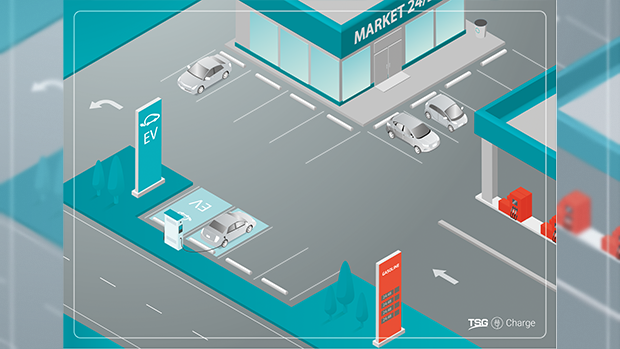
Side EV charger configuration: Forecourts can add a charger to the existing Distribution Network Operator (DNO) connection, allowing drivers to stop and take advantage of adjacent retail and food offerings while charging. Retailers such as TotalEnergies and Avia are moving away from the traditional fuel-only forecourt to include at least one charger on the side of the forecourt. Such actions position these players and their commitment to welcome cleaner energy sources and understand the latest customer preferences.

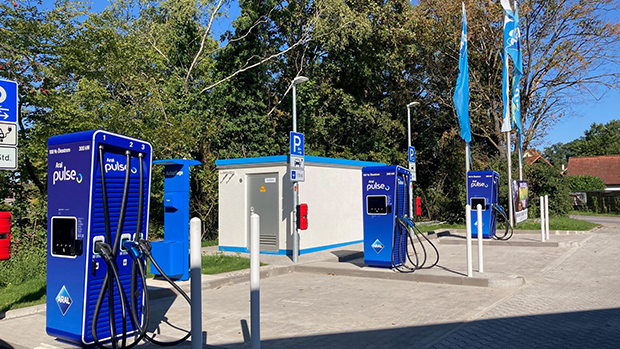
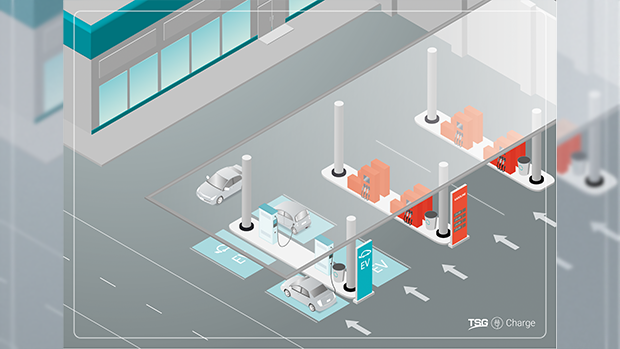
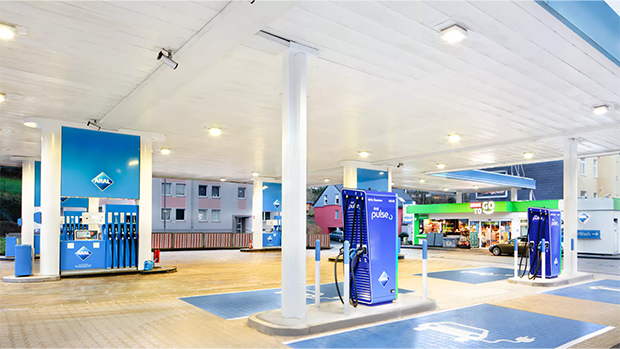
Integrated EV charger configuration at the forecourt: Depending on the grid and the demand for charging, a single charger at the forecourt may not be sufficient. Some retailers are opting to renovate their forecourts and convert them to partially electrified forecourts, where EV chargers and dispensers are close by and EV drivers have direct access to the convenience store. This is the case with some bp Aral stations, which include both chargers and dispensers under the canopy, respecting the safe distances between the electrical and fuel components to avoid accidents (ATEX zones).
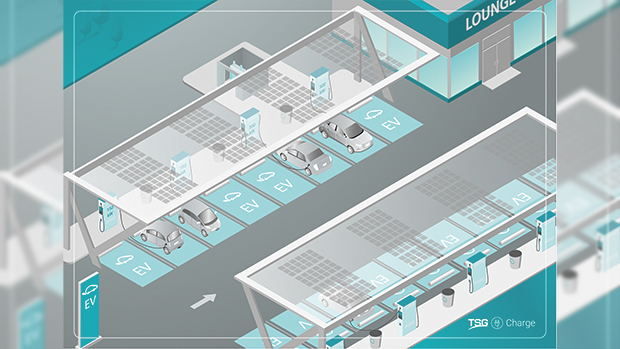
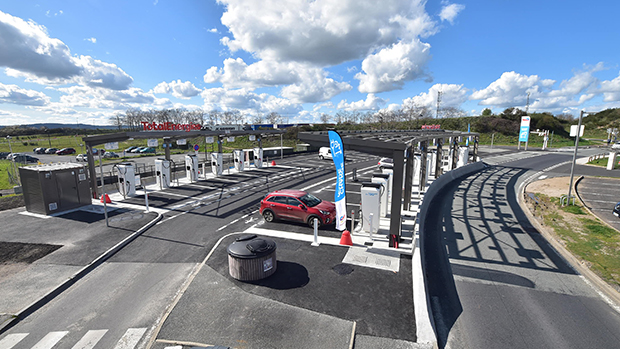
Separate (and dedicated) EV fast-charging hubs: Dedicated EV charging hubs with rows of fast chargers are a solution for the busiest locations where the need for charging may be highest. Motorways now have larger, dedicated EV parking areas where drivers can stop and charge both their cars and themselves, as these hubs tend to offer other services such as food and drink. These can be located close to forecourts and rest areas, usually covered by dedicated solar canopies, and operate as stand-alone businesses along roads and at key traffic nodes. TotalEnergies has completed installations of this type.
What are the business benefits of a service station adding EV chargers?
EV drivers are demanding and look for more than the traditional forecourt offer. Before, drivers had time for a coffee and a snack during the refilling of their ICE vehicles, but with the increased time at the forecourt they can stop for a complete meal. This results in a 3 to 4 times higher purchase basket, and a preference for better equipped places with access to extra facilities, even if they are more expensive.
This is relevant for operators who want to offer a more balanced fuel-retail offer, which makes sense from a revenue perspective as margins are usually driven by the retail part of the business. Particularly in a scenario of competitive energy prices and types, investing in non-fuel business opportunities supports an enhanced customer experience and generates additional profit for the station.
In general, forecourts are strategically located in high-traffic areas: on motorways to allow long-distance journeys, or in optimal locations in high-density areas such as cities. This means that these stations can now – and already do – include electric charging points for cars and vans. Very soon, they will be able to add spots for medium-duty vehicles and, soon, for long-haul electric trucks. Charging e-trucks will be the next major mobility transition, and operators are already considering it.
New energy offers and a multitude of business possibilities
Forecourts that are becoming multi-energy incorporate electric power and other cleaner options, such as biogas and even hydrogen. As such, several cross-selling opportunities arise from the time customers need to charge these new energies. Coffee and lunch, as well as car wash and air compressor options, are traditional services for filling stations; but large and comfortable rest areas and facilities, parcel pick-up points, gyms or spa areas, and sit-down restaurants are possible additional solutions. Even more upgraded services – lunch lounges, coworking spaces and hairdressers – are options that bring convenience to drivers and more revenue streams to forecourts.
Major players are renovating forecourts with more retail services and a better customer experience to capitalise on the business opportunities of longer stays. All in all, the disruption caused by EVs is an opportunity to rebalance the station and include more retail options, ultimately creating more business.
EVs are here to stay, supported by the need to decarbonise the transport sector, new regulations, falling vehicle prices and increasing customer uptake of electric cars. Forecourts can benefit greatly from this movement by incorporating EV chargers or creating or welcoming dedicated charging hubs nearby. As EVs popularise, the traffic per charge point improves each year and brings stations closer to profitability.
TSG is the right partner to enable the energy transition of forecourts to multi-energy mobility hubs. We are the leading provider of technical services in Europe and Africa to support the responsible transition of mobility, allowing public spaces to evolve and accommodate new energies. We design, plan, install and maintain turnkey solutions tailored to each company's needs and requirements.
Contact TSG to find out how we can enable the transformation and electrification of your forecourts.