Driving the energy transition: MADIC at the heart of decarbonized mobility
Published on: Apr 14, 2026
Advertorial
Faced with climate challenges, the energy transition calls for a profound rethinking of the transport sector, which still emits large amounts of greenhouse gases. In France, public authorities have identified several complementary levers to achieve decarbonization goals: vehicle electrification, low-carbon hydrogen, and biofuels. The MADIC group, a key player in this transition, designs innovative and high-performance technical solutions, perfectly suited to new energy challenges.
Electromobility
Today, there are 2.5 million charging points, including more than 168,000 open to the public. The government has reaffirmed its commitment to supporting the deployment of EV charging infrastructure, which has accelerated since 2020 and is expected to continue, reaching 400,000 public charging points by 2030, including 50,000 fast-charging stations.
Meanwhile, charge point operators (CPOs) also have ambitious plans. Electra aims to reach 2,200 stations and 15,000 high-power charging points by 2030. Fastned is targeting 1,000 stations across Europe by 2030. These companies demonstrate that the rollout of fast-charging infrastructure is progressing at a sustained pace.
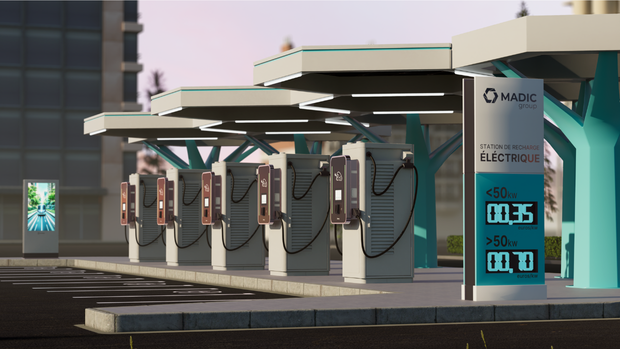
In this context, the MADIC group stands out in the market by offering robust and innovative technical solutions tailored to the demands of this transition. Since 2010, its subsidiary, MADIC industries, has developed a complete range of PULSE AC and DC charging stations, designed to deliver optimal performance in terms of power and energy management. The group also provides full installation and maintenance services, as well as integrating its own payment solutions into the PULSE range.
MADIC charging stations are distinguished by ultra-fast charging, advanced connectivity, secure payment solutions, and modular products that can evolve over time.
Electromobility, and in particular the services offered by MADIC, forms the foundation of decarbonized mobility and significantly reduces emissions from passenger cars and light commercial vehicles. However, certain uses (heavy transport, long-distance travel, logistics) may require other technologies such as hydrogen or biofuels, which are also developed by the group.

Hydrogen
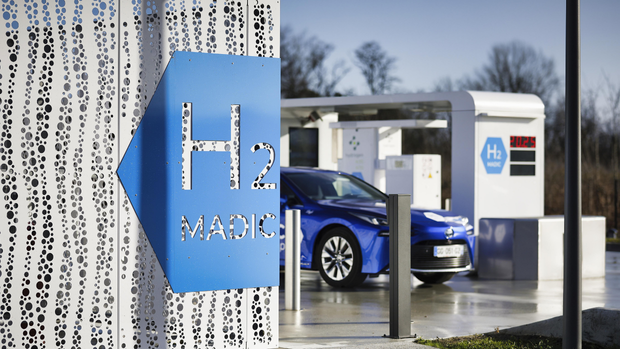
In response to the challenges of the energy transition, road mobility, particularly heavy transport, must evolve toward new models incorporating a range of energy solutions, depending on use and needs. According to the European Commission, renewable hydrogen could cover nearly 10% of the European Union’s energy needs by 2050.
In this dynamic, the MADIC group positions itself as a key player in the development of hydrogen, actively contributing to the rollout of this future energy across the country.
Its strategy is based on a comprehensive approach to the lifecycle of distribution stations, from design and construction to maintenance and supervision. Thanks to in-house tools such as MAGVIEW, the group provides real-time monitoring, allowing operators to track station status, plan and anticipate maintenance needs, monitor financial indicators, and ensure optimal availability.
With the installation of a laboratory station at its technology hub in Saint-André-de-Cubzac, near Bordeaux, MADIC is advancing the development of hydrogen mobility while offering its technicians a valuable opportunity to build new skills.
Some of the group’s 450 technicians, along with technicians from its clients, will be trained at this facility to maintain hydrogen installations. The station has a daily capacity of 400 kg, with the potential to scale up to 800 kg.
Biofuels
It is also worth noting that, within the electric heavy vehicle sector, only 1,500 electric trucks are currently in operation in France out of a total fleet of 625,000 vehicles. In this context, biofuels represent a practical lever for decarbonizing uses that are difficult to electrify (long-distance, heavy-duty, aviation, maritime).
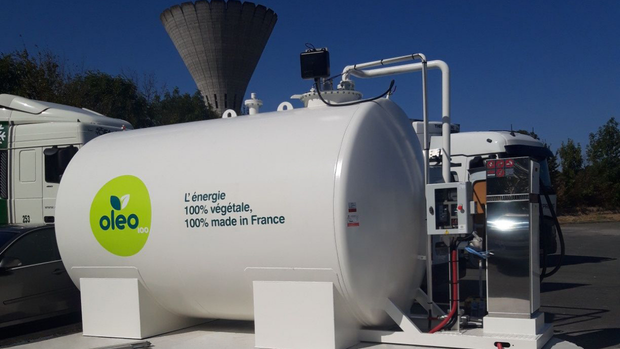
For more than five years, MADIC has been firmly committed to this sector, actively contributing to the development and distribution of biofuels across the country. A pioneer in sustainable mobility solutions, the group supports its subsidiary MADIC industries with an integrated and high-performance offering, including horizontal and vertical storage tanks of all capacities, BOXTER 10 distribution terminals known for their reliability and ease of use, and additional filtration kits ensuring fuel purity.
With this expertise, MADIC confirms its leading role in the transition toward cleaner and more responsible mobility.
In an energy landscape undergoing rapid transformation, the ability to adapt is becoming a decisive advantage. Rather than betting on a single technology, MADIC has chosen an integrated approach that encompasses the full range of low-carbon mobility solutions.
Electric, hydrogen, biofuels: the group already has the technologies, infrastructure, and services needed to support operators, whatever their energy choices and operational constraints may be.
This is a strategic position in a sector where the success of the transition will depend less on a single solution and more on the ability to intelligently orchestrate multiple energy sources, to deliver mobility that is both sustainable and profitable.