Variance & Tank Gauge Calibration: Why Middle East Fuel Operators Are Pushing for Accuracy
Published on: Nov 25, 2025
Advertorial
Titan Cloud recently brought together regional leaders to discuss what is actually happening inside tanks across Kuwait and Saudi Arabia and what operators can do to get ahead of variance issues. The panel included Essa I. Al-Moosa of B.Online Kuwait, Saboor Chohan of Wafi Energy, the Shell licensee in KSA, and Titan Cloud’s Gaurav Chowdhury and Amer Bakarman.


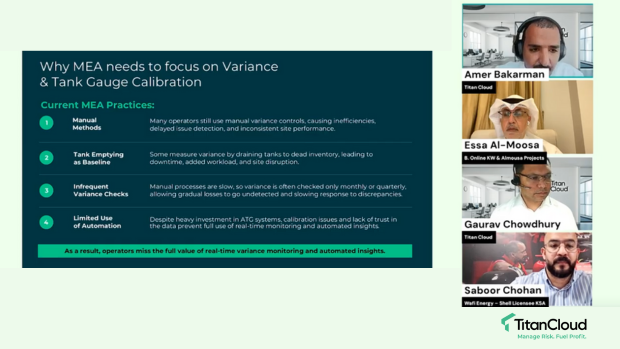
Inventory variance is a global issue, and operators everywhere face similar pressures when visibility and calibration accuracy fall short. The financial impact is significant. Underground storage tank leaks cost retailers millions each year, and regulators widely recognize statistical inventory reconciliation as an effective early detection tool. Here, we focus on how these challenges surface in the Middle East.
Titan Cloud recently brought together regional leaders to discuss what is actually happening inside tanks across Kuwait and Saudi Arabia and what operators can do to get ahead of variance issues. The panel included Essa I. Al-Moosa of B.Online Kuwait, Saboor Chohan of Wafi Energy, the Shell licensee in KSA, and Titan Cloud’s Gaurav Chowdhury and Amer Bakarman.
What came through in the conversation is that many fuel networks in the region have outgrown manual methods. The need for accurate, dependable data has moved well past what dipsticks and rough estimates can deliver.
Variance Runs Deeper Than a Single Number
Amer Bakarman explained that most operators still view variance as a single number. In practice, it falls into three categories:
- Real variance from leaks, theft, short deliveries, or over-dispensing
- Apparent variance caused by temperature swings, tank deformation, timing issues, or inaccurate tank charts
- Hidden variance created when manual readings or spreadsheets mask the true picture
The regional climate makes these issues even more complex. Fuel expands and contracts quickly with temperature changes, and older tanks often settle or tilt over time, which makes uncalibrated gauges unreliable.
Many operators still rely on dipsticks or tank emptying as a baseline. It is familiar, but it leads to inconsistent results.
“Without calibration or reliable charts, the empty point becomes the baseline,” Amer said. “Teams compare the bill of lading to sales and hope it lines up. Most of the time it does not.”
These methods are slow and often inaccurate. They also allow variance to build for weeks or months before anyone notices. Research shows that ATG readings drift over time and require regular calibration to remain accurate.
In many cases, operators have the tools they need but do not trust the data. That lack of confidence keeps teams from using automation to their full potential.
The Variance Pressure Points in KSA
As Saboor Chohan noted, variance in Saudi Arabia often starts before fuel reaches the station.
Fuel warms during transport. Many trailers are not calibrated, so tanker dips rarely match documented volumes. Theft can occur in transit. Once fuel is dropped into the underground tank, accuracy depends entirely on whether the tank and ATG are calibrated.
“Underground tanks shift, tilt, and change with groundwater levels,” Saboor explained. “Even a calibrated ATG needs recalibration over time.”
Operational gaps, inconsistent data, and limited transparency across networks make it difficult for teams to pinpoint where variance is coming from. That is why many staff spend time reacting to issues instead of preventing them.
Why Book Inventory Rarely Balances
Gaurav Chowdhury shared a data point that stood out to the audience. Bill of lading volume matches ATG delivery less than 1 percent of the time.
Several factors are involved. Temperature swings, tank deformation, meter drift, delivery issues, and theft all contribute to inaccurate balances. Studies show that even a 0.5 percent drift in dispenser meters can meaningfully impact annual profitability.
Digital calibration helps close these gaps. Titan Cloud’s digital tank charts capture thousands of data points across deliveries, temperature readings, and inventory movement. This high-frequency data recreates how each tank behaves and produces a more accurate calibration model than traditional tank charts.
Bringing SIR to Manual Sites
Even at locations without automation, statistical inventory reconciliation (SIR) drives measurable improvements.
“For manual sites, we collect sales, inventory readings, and delivery data in the simplest way possible,” Gaurav said. “We run it through the same SIR engine used for automated sites. You get earlier leak detection, cleaner variance reporting, and fewer surprises.”
This matters in the Middle East, where many networks operate with a mix of manual and automated locations. Essa Al-Moosa described a challenge many operators recognize.
“For years, teams relied on manual dipping. It is familiar, but it is also where most variance comes from,” he said. “A single misread can distort everything. Stations may even stop operations just to recheck readings, which means lost time and lost sales.”
Software removes that uncertainty. It eliminates human error, provides real-time visibility, and gives operators confidence in the numbers. Most importantly, it allows teams to make decisions without slowing the business down.
“It is not just about adopting technology,” Essa said. “It is about changing how fuel stations in Kuwait and the Middle East operate. Faster, smarter, and with far more accuracy.”
The pressure to modernize is increasing. Retail fuel volumes across the GCC continue to grow as populations expand and infrastructure develops, raising the need for tighter controls and better data. Operators who shift to digital calibration, SIR, and trusted ATG data will have a clearer operational picture and fewer costly surprises.
The full session is available on demand. Watch the webinar and contact Titan Cloud if you want support improving accuracy and reducing variance across your sites.