forecourttech 2025: International leaders explore the future of mobility and retail
Published on: Oct 7, 2025
From AI and EV charging to retail media and loyalty, the two-day event explored the forces driving transformation in mobility and convenience in Alicante, Spain.

Last week, forecourttech 2025 reaffirmed its role as one of the most influential gatherings in the global forecourt and mobility industry. Over two days, leaders, innovators, and experts from across Europe and beyond came together to share insights, challenge assumptions, and explore the forces shaping the future of roadside retail.
The new era of roadside retail
From the very first session, the tone was set. Christian Warning of The Retail Marketeers, together with NACS Global Director Mark Wohltmann, industry veteran Frank Gleeson and Jörg Heilingbrunner, CEO of Scheidt & Bachmann, mapped out the forces reshaping convenience retail — from evolving foodservice expectations to the rapid integration of EV charging and new payment models. As Warning reminded attendees, the sector is now “at the intersection of energy, hospitality, and technology,” where success depends on how quickly businesses can adapt to shifting consumer behaviour.
Technology sits at the heart of this shift. Solutions now extend far beyond selling fuel to include self-checkout, autonomous stores, and AI-driven customer engagement. As Heilingbrunner argued, integrating AI is no longer optional: it is essential for understanding consumer behaviour and personalising offers in real time, even predicting demand and adapting in-store displays dynamically.
That theme of transformation ran through the entire programme. PDI Technologies’ David Anderson explored how data integration is rewriting the rules of consumer understanding, while Moeve’s Robert Buan made the case for AI not as a future prospect but as a present-day retail tool.
“AI today is unlocking opportunities we couldn’t have imagined just a few years ago. But it’s not a silver bullet — it’s a tool. And like any tool, it needs strategy, planning, and human judgement behind it,” said Buan.
Máté Tilk explained how MOL’s Digital Factory illustrates the transformation of the integrated energy player. This shift is anchored in three pillars: expanding MOL’s retail capabilities to become a full-fledged consumer goods and convenience player; leading the mobility revolution in Central and Eastern Europe; and leveraging Digital Factory to digitalise both customer interactions and internal operations through loyalty, apps, and advanced analytics. The result is a rapidly growing ecosystem, with MOL’s MOVE app already among the top consumer platforms in the region with 5.4 million users today and an ambition to reach 10 million by 2030.
Richard Campion, Head of Fleet and Business Mobility at VISA, highlighted how payment innovation is reshaping spending trends in the fuel and mobility sector. He emphasised VISA’s pivotal role in transforming fleet payments with open-loop solutions that offer universal acceptance beyond single-brand networks.
Beyond the main-stage discussions, one-on-one meetings remained a defining feature of forecourttech, giving retailers, suppliers, and technology partners a unique opportunity to connect directly, exchange ideas, and explore collaboration in a focused setting.
New business models and digital strategies
Day two deepened the conversation. A keynote from Transformation Retail’s Nir Manor revealed the billion-dollar promise of retail media networks and how forecourts can become high-margin advertising platforms. The session described retail media as the third major wave in digital advertising, reaching $30 billion in spending in just five years (far faster than search or social) and poised to surpass them. Fueled by first-party data, the rise of e-commerce, and the decline of traditional media channels, retail media enables highly targeted, high-intent advertising at the point of purchase.
In a forward-looking fireside chat, Jan-Harmen Akkerman and Christian Warning explored how digitalisation is reshaping customer relationships and business models in mobility. They highlighted Generation X as a crucial yet often overlooked demographic, now controlling wealth across three generations and representing a key target for new mobility services. One of the most profound shifts they discussed is the decoupling of payment from the moment of service, much like how public transport evolved from physical tickets to seamless digital access, fueling and charging are moving toward models where customers access services first and pay later, or bundle them into monthly subscription plans.

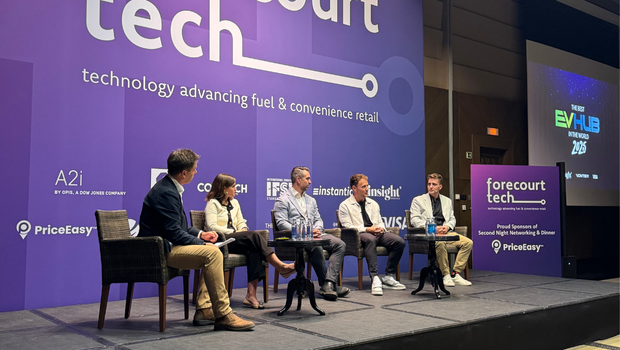
The AI panel featuring experts from BigBrother, Omis, Locatium, and Shell offered a grounded and forward-looking view of how artificial intelligence is reshaping fuel and convenience retail. Panellists emphasised that AI is not adopted for its novelty but for the real value it delivers — from improving maintenance accuracy by analysing photos of faulty equipment to cutting data analysis time from hours to minutes, freeing teams to focus on strategic decisions. They cautioned against overestimating AI’s capabilities without proper context and stressed that AI is only as good as the data and instructions it receives. Collaboration and careful partner selection were highlighted as critical for successful deployment, as was a relentless focus on ROI and measurable business outcomes.
Boost EVs, protect data
The EV debate involving Insight Research, VISA, Gilbarco Veeder-Root, and Kempower captured the industry’s most pressing questions as fuel retailers and charge point operators grapple with their future roles. A central theme was that EV charging is a natural extension of fuel retail’s legacy, yet competition is reshaping the landscape as drivers gain more options to charge at home, at work, or in public spaces.
Speakers highlighted how consumer expectations are shifting beyond price. While most fuel customers still prioritise the cheapest site, EV drivers are willing to pay for convenience — on average a 37% premium to avoid a five-minute wait, according to recent survey data. That willingness underscores how critical it is for operators to offer fast, seamless, and reliable charging experiences.
“The early adopters who were willing to accept limitations are gone. Today’s customers are focused on convenience. We recently ran a survey with over 4,000 drivers across the EU, and what they overwhelmingly want is the same thing they expect from traditional fueling: consistent, convenient service,” said Merrick Glass, President, Konect at Gilbarco Veeder-Root.
And as Titan Cloud’s panel with ExxonMobil, Dover Fueling Solutions, and Q1 Energie reminded everyone, the future will hinge not just on innovation, but on secure, connected data ecosystems that underpin every part of the business. The discussion explored how seamless data connectivity is becoming the backbone of modern roadside retail — powering everything from EV charging and loyalty programmes to real-time site operations. The panel highlighted the growing complexity of data flows across retail networks and the need for robust cybersecurity strategies to protect customer, payment, and operational data against evolving threats. They also addressed the challenge of modernising legacy IT systems without disrupting uptime, the importance of regulatory compliance, and the critical role of collaboration in managing third-party risks.
Stephen Bozdan, Managing Director of SAB Events Europe, the organiser behind forecourttech, closed the event by highlighting its growing importance as a global meeting point for the fuel, mobility, and convenience sectors. Bozdan also announced that the event will return to the Asia Gardens Hotel in October 2026, continuing its mission to shape the future of roadside retail in an era defined by rapid transformation and new mobility trends.