From queue to app: Why the payment process at the pump is on the brink of revolution
Published on: Sep 4, 2025
Advertorial
From banking to grocery shopping, our world has become seamlessly digital. Yet, the traditional process of paying for fuel remains a point of friction—not just for drivers, but for the entire industry.
For drivers, this is most visible in the queue at the checkout, an inefficient ritual in their modern mobility journey. But for fuel station operators, this same process creates a cascade of operational challenges: fueling spots are cleared slowly, reducing throughput, especially in peak times; staff are being tied up processing simple payments instead of assisting genuine shoppers; and the overall in-store experience is slowed down by customers who are in a rush and only want to pay and leave quickly.
Meanwhile, for fuel card issuers, the reliance on physical plastic cards has always come with significant costs and security vulnerabilities. From the high cost of producing and managing cards to the ever-present risk of skimming fraud at payment terminals, the analog card, while a reliable medium and far superior to cash, is a constant source of inefficiency and risk. This outdated system creates unnecessary costs and issues across the entire value chain. The good news is, it's surprisingly easy to solve.



These are not just perceived annoyances; they are documented pain points impacting efficiency and driver satisfaction. In June 2025, the market research institute bms conducted a study commissioned by PACE Telematics. The study surveyed 300 German company car drivers to understand their primary needs.The results were unequivocal: the top priorities for drivers of company cars are time savings and avoiding queues at the checkout. This clear market demand signals a fundamental shift in user expectations.
While this demand for speed raises concerns about in-store revenue for some industry representatives, experience shows that digital payment can actually increase shopping cart sizes and enhance profitability. It separates "fuel-only" customers from genuine shoppers, improving store ambiance and increasing pump throughput on the forecourt. More importantly, the app itself becomes a powerful marketing tool and communication touchpoint, delivering targeted offers to the driver's screen to encourage planned in-store purchases. This transforms a simple payment into a modern, targeted retail opportunity.
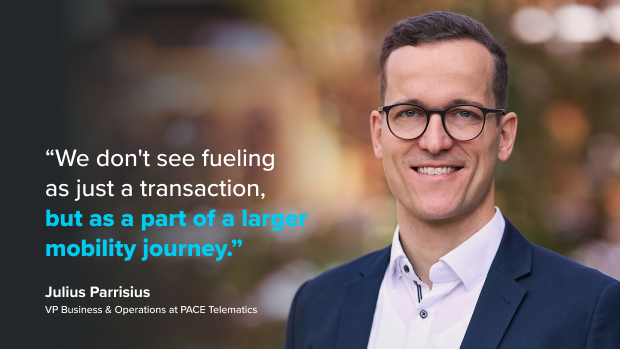
"We don't see fueling as just a transaction, but as a part of a larger mobility journey," says Julius Parrisius, VP Business & Operations at PACE Telematics, the European market leader for mobile payment at gas stations. "What's truly revolutionary is that for the first time, we are creating a regular, digital touchpoint directly at the pump. This opens up a world of new opportunities for the entire ecosystem. For fuel retailers, it's a powerful tool for digital upselling and cross-selling. For fleet management, it's a leap forward in efficiency that reduces administrative overhead, provides robust fraud prevention, and offers the data-driven insights needed to manage the total cost of ownership. That's why the question isn't if this will become the standard, but how quickly."
The Technology Behind the Revolution
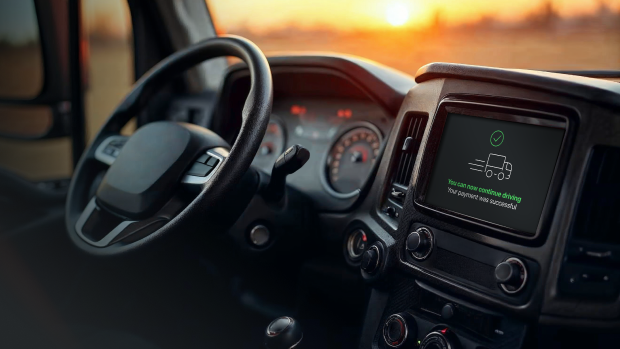
Powering this shift is PACE Connected Fueling, Europe's leading platform for mobile payment directly at the pump. It is a fully digitalized payment infrastructure designed to connect the entire mobility ecosystem: from fuel card issuers and gas stations to mobile app providers, fleet management systems and truck or automotive manufacturers. Through this platform, drivers can pay quickly, conveniently, and securely via various apps on the smartphone, smartwatch, or directly in-car or in-truck — contactless and without a physical card.
Making this possible requires a robust and open technological backbone. "Our goal from the beginning was to avoid creating another closed, isolated solution. Instead, we are providing a platform solution for the whole industry. It is the only way that costs and integration efforts can be kept manageable for the players in our industry who are confronted with energy transformation, sustainability goals and several other challenges in parallel." explains Parrisius. "As an example, with our OpenFSC (Open Fuel Site Controller) interface, we helped establish an industry standard that securely connects gas stations from various brands to the cloud. As the first and only provider to digitize fuel cards on a large scale, we are leading this movement. In the same spirit, we have introduced standard interfaces for integration into telematics and fleet management systems."
This platform-based approach, supported by versatile integration options via APIs, allows for cross-platform compatibility. The same secure technology can power a payment feature in a consumer-facing mobile app, a smartwatch, or be integrated directly into truck telematics systems.
A Glimpse into the Future of Mobility Payments
The revolution that begins at the fuel pump is set to redefine the entire roadside retail experience. The same infrastructure that enables seamless fueling can be extended to include EV charging, washing, and even in-store purchases, all handled through a single, secure digital identity.
Fuel card issuers can gain a competitive advantage by offering a digital card solution. This allows them to establish digital touchpoints with customers and drivers and respond to growing customer demands. For fleet managers, this means a new level of security and administrative efficiency, eliminating the risks of card fraud and the hassle of paper receipts. For drivers, it means increased plannability and reclaiming valuable time. And for the fuel retail industry, it presents an opportunity to transform their sites into modern mobility hubs, increasing throughput in peak times, and maximizing loyalty of customers who value this digital service.
The message from the market is clear: drivers are ready to move on from the traditional payment process. With a secure, scalable, and open platform, the technology to meet their demand is already here. Our industry will do well to heed this call early, ensuring we are the architects of this transformation, not its casualties.
To learn more, visit PACE Telematics.