Q&A with Viju Pullan (DFS): “Existing stations have the edge in a multi-energy future”
Published on: Dec 2, 2024
Viju Pullan, Global Alliance Director at Dover Fueling Solutions (DFS), discusses how service stations are adapting to a multi-energy future, the complexities of implementing alternative fuels, and the technologies that will shape the future of mobility.


Question. We are heading towards a multi-energy future for road transportation. What’s the role of service stations in this scenario?
Answer. The multi-energy future is something that is undisputed. We are rapidly navigating a fast-tracked, complex, techno-commercial journey of energy transition to achieve that brighter, cleaner future.
The two guiding rails of this journey are technology and business viability, which must move hand in hand. Technology is already available and will continue to evolve, but the growth of new energy types will need to follow business demand and viability. By viability, I don’t just mean the return on investment – it also involves factors like enabling regulations, permitting processes, land availability, and interconnectivity.
At its core, the energy retailing business is about monetizing customer touchpoints and the time customers spend at a station. A customer is a customer, whether they are refueling with traditional fuels or cleaner alternatives, they still need coffee. Therefore, it's best to align the multi-energy strategy with the existing backbone of traditional fuel and non-fuel parts of the mobility business.
Q. How should retailers go about adapting their sites to these changes?
A. Existing station owners already have an edge here. They can maximize the use of their land, infrastructure, site staff, automation systems, payment methods, reporting tools, and loyalty programs. With these multiple advantages, it’s a no-brainer for fuel station owners to evolve into multi-energy providers wherever possible. Those who don’t risk losing customers and business over time.
At DFS, we offer a broad range of technological solutions for mobility retail and focus specifically on interoperability. For example, the site automation and payment solutions offered by DFS factor in the standardization of the customer journey around liquid fuels, LNG, H2, and EV charging. Fuel dispensers and ATGs are designed to handle higher percentages of ethanol and biofuels, future-proofing investments. The DFS additive dispensers allow customers to free up underground tank space for greener liquid fuels. These are just a few examples of how DFS uses innovation to simplify the complexities of the energy transition.

Q. How difficult is it to manage regulatory changes and market dynamics when implementing new energy types?
A. That’s a very important topic. While governments are making efforts there is a pressing need to fast-track regulatory enablement. That is also the case in Europe, which is considered relatively advanced. For instance, DFS offers turnkey LNG solutions and retrofit options for existing LNG sites. The retrofits improve efficiency and reduce operating expenses.
However, the complete timeline for these projects often spans years. Much of that time is consumed in obtaining or amending the permits, which increases costs and delays project delivery. These delays also expose projects to market dynamics. For example, high stockpiles of EV chargers in U.S. warehouses await infrastructure readiness, but by the time they are deployed, the technology may already be outdated.
We’re navigating a world that has just emerged from post-COVID hyperinflation, faces geopolitical tensions and supply disruptions, and continues to experience fluctuating government policies. These factors naturally affect the sentiments and commitments of stakeholders in the energy transition. There is a lot of pressure to act around climate change.
Q. What are the technical challenges of operating a multi-energy station?
A. Before diving into specific aspects let’s take a broader view. The global fueling economy has relied on oil for centuries, and oil has defined acceptable thresholds for safety, cost, and convenience. Any alternative energy must meet or exceed these benchmarks, both for customers and operators.
Multifuel sites naturally bring increased technical complexity, and the expertise required to operate and support these networks efficiently grows accordingly. This is where technology like remote station management plays a crucial role. It ensures high uptime, lowers operating costs, and minimizes health and safety exposure.
To manage the energy transition while keeping operating costs under control, we see retailers allocate fewer resources toward these. But traditional fuels remains crucial. This paradoxical challenge is expected to result in issues around HSSE and non-metered interruptions. Among other things, DFS is trying to tackle this by introducing remote diagnostics and management solutions.
Q. What have you learned from the introduction of fuels like LNG and CNG?
A. We can draw lessons from recent industry experiences. The introduction of CNG and AdBlue began with specialized solution providers and high setup costs. Over time, as regulations evolved, provider expertise segmented, and volumes grew, these ecosystems became more practical and viable.
It will be the same case for new energies. In the early stages, adoption rates and volumes for new energies will be low. Collaboration and synergy between industry experts in areas like regulation, safety, technology, and customer engagement will be essential. Once the framework is in place, market forces and competition will drive efficiency and stabilization into the system.
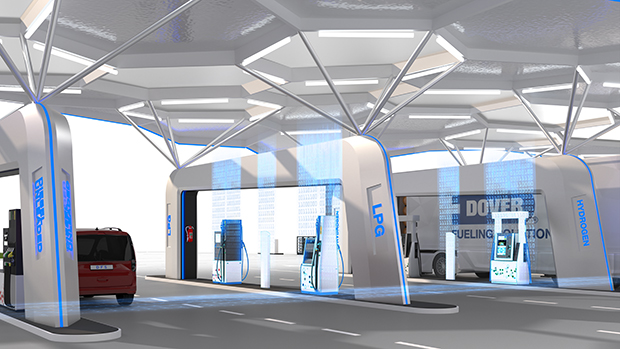
Q. Hydrogen is a fuel that poses very specific challenges. How do you see the growth of H2 in the retail segment?
A. With its portability, low noise, and small footprint, H2 stations can be easily integrated into multi-fuel sites. However, the energy-intensive and high-cost processes of producing and storing hydrogen remain its main disadvantages. It can only have the sustainable fuel label when the production of H2 is green.
As a retail fuel, it is crucial to develop a viable business case, which hinges on the initial CAPEX and usage levels. Today that’s an issue with H2. Additionally, the technology for hydrogen usage in vehicles, such as fuel cells or liquid hydrogen, is still evolving. That said, green hydrogen has shown promise in dedicated applications, like refueling depots for hydrogen buses and trucks.
Q. From a geographical perspective, which markets are currently making a big push for certain energy types?
A. Globally, China and the EU are leading with significant pushes for EVs and LNG. India is also developing strategies to diversify into LNG. Hydrogen had a promising start in regions like Germany, California, Japan, and Korea, but it still requires more time to establish an economically viable ecosystem. The U.S., the largest economy, will have its own trajectory with the new government, for us to wait and see. In the rest of the world, many oil-dependent economies are focusing on quick wins with ethanol, biofuels, synthetic fuels, and e-fuels.
Q. How challenging is it for a supplier like DFS to stay on top of the market with so many changes happening across the world at different speeds?
A. The energy transition is challenging but also presents a tremendous opportunity for companies that can navigate its complexities. DFS, through its global brands like OPW, Wayne, and Tokheim, has been a market leader for over 130 years.
DFS excels in dispensing, automation, and payment solutions for liquid fuels, EVs, CNG, hydrogen, and LNG. With our experience, we’ve become an authority on customer touchpoints.
Given the fragmented and low-volume nature of new energy markets, it remains a challenge to stay ahead and commit resources effectively. This is why we emphasize collaboration. Stakeholders must consolidate efforts and engage in specialized areas to accelerate market adoption. As business volumes grow, costs will come down, making the transition more economically sustainable.
Let me conclude by saying that transitioning to a multi-energy ecosystem is not just a business imperative – it’s a vital step for developing a cleaner environment, for the survival of our species on this planet, and we are the fortunate generation chosen to play a pivotal role in this mission.