Turning dwell time into business
Published on: Jun 16, 2025
As electric vehicles surge past 100 million globally, fuel retailers are still defining their charging strategy. New data shows over 70% of EV drivers still plug in on the go, and smart retailers can turn that dwell time into sales. We speak to Héloïse de Paulou Massat, Principal at Oliver Wyman, about how to seize this opportunity.
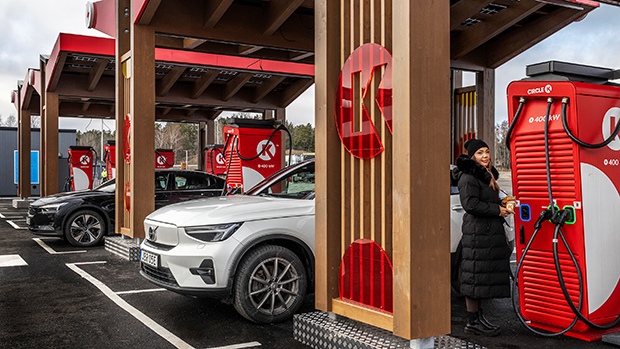

As electric vehicles (EVs) cement their role in mainstream mobility (global stock soared from just over 1 million vehicles in 2013 to nearly 100 million in 2024) many fuel retailers and convenience brands wrestle with an uneasy question: is public charging truly worth the investment?
It’s tempting to dismiss it as niche. After all, more than 90% of EV owners have access to private or shared charging at home or work. But, as Oliver Wyman’s extensive driver survey shows, real-world behavior tells a different story: more than 70% of these drivers still use public charging regularly. And notably, about a quarter do so not out of necessity, but out of convenience; a chance to shop, eat, or run errands while topping up.
“Public charging might look like a small piece of the puzzle on paper, but the behavior is clear: people actively choose to charge near other destinations. That’s an opening for retailers to capture incremental traffic,” says Héloïse de Paulou Massat, Principal at Oliver Wyman and a specialist in energy and natural resources.
Supermarkets, parking garages, and fuel stations: The Big Three
Oliver Wyman’s consumer research highlights where drivers want more plugs: supermarkets and shopping centres top the list (41% of respondents ranked them among their top two choices), closely followed by parking garages (39%) and existing petrol stations with EV charge points (35%). Interestingly, dedicated EV hubs are slightly behind in consumer preference in many countries.
“Consumers still prefer familiar places. Fuel stations have the advantage of established infrastructure and trusted brands. Dedicated hubs are emerging, but they often lack the food and retail elements people expect. Some pure players like Fastned are starting to pilot convenience retail in Belgium, but it’s early days,” notes de Paulou Massat.



Time on site: A window for revenue
For retailers, the real opportunity lies in how long drivers stay. The average public charging session clocks in at around 35 minutes, with 51% of drivers spending 15–30 minutes per session and another 15% staying up to an hour.
Behavior patterns show that 53% of drivers leave their vehicle to visit a facility or store on-site, while 47% wander off-site to nearby commercial destinations. This means the on-site offer must compete with surrounding cafés and restaurants.
“About 50% of drivers leave their vehicles and visit a nearby facility. Half of those go to the site directly next to the charger. So roughly 25% enter the convenience space adjacent to the charger. That’s very similar to what we see at traditional fuel stations, except drivers spend more time,” de Paulou Massat explains.
When asked what amenities they prefer during a charge, 42% pick cafés or coffee shops, while 30% want quick-service restaurants, signaling that a basic shelf of impulse snacks isn’t enough for this new audience.
Getting the offer right: Speed still rules
If there’s one non-negotiable in public charging, it’s speed. According to Oliver Wyman’s global survey, 79% of drivers cite speed and wait time as their top site selection criteria, outpacing location and even price. Yet legacy public chargers have often fallen short: 87% of drivers complain about slow speeds, while 84% have encountered broken chargers or confusing instructions.
“People are willing to pay more for faster charging — UC Davis data shows that drivers would pay 50% more per kilowatt-hour for a 100 kW speed boost. But there’s a catch: if you promise ultra-fast, it needs to deliver. A single failure can push people away for weeks,” says de Paulou Massat.
Designing hubs in a smarter way
To avoid stranded capital, winning operators adopt a phased strategy. Typical best practice includes installing robust grid connections and a few chargers first, then expand capacity as traffic builds. Stations typically become profitable at around 10% utilization rates, but ramping up to that threshold requires time and local demand growth.
Maintenance and reliability are the two pillars on which to build on. Operators increasingly combine third-party maintenance contracts with in-house technical teams and 24/7 monitoring to detect faults proactively. “We see leaders balancing cost-efficient outsourcing with critical internal know-how. You can’t fully delegate charger availability to someone else if your brand reputation is on the line.”
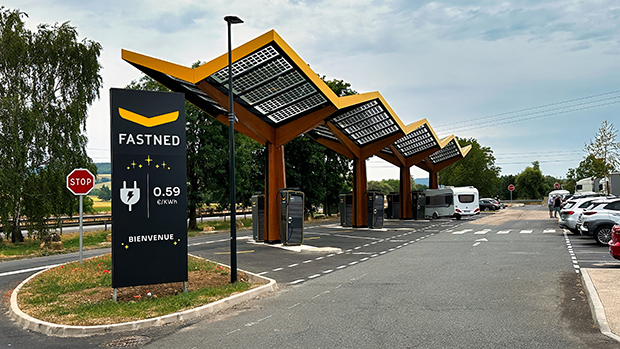
Some new players are reimagining the look and feel of public charging. Fastned and Clever’s nature-inspired stations with solar canopies and integrated retail, or Electra’s user-friendly interactive stations with entertainment options, show where the bar is heading. Modular designs allow sites to scale charger count and speed as technology evolves, future-proofing expensive grid upgrades.
“These new designs aim to shift away from the harsh, functional vibe of legacy fuel stations. It’s about creating a clean, premium, and even relaxing experience. People don’t want to feel like they’re just killing time in a car park,” says de Paulou Massat.
Europe’s outlook: A time of transition
Regionally, Europe is a mixed picture. Norway and Denmark lead the way in adoption and infrastructure maturity. In Western Europe overall, Oliver Wyman projects a short-term oversupply of chargers relative to demand, which is necessary to reassure early adopters, but the oversupply also means some sites will struggle to cover costs. This sets the stage for consolidation: larger oil and gas firms, utilities, or scale-ups are expected to absorb weaker networks.
“Some oil and gas incumbents are moving fast — TotalEnergies in France is an example. Others are more cautious, especially if they operate via franchisees who have to shoulder the CapEx,” notes de Paulou Massat.
For convenience retailers, public charging isn’t just a nod to sustainability trends. It can be an insurance policy for site traffic as traditional fuel volumes decline. By delivering a reliable, fast, and comfortable experience, forward-thinking operators can convert charger dwell time into store footfall.
“Ultimately, it comes down to understanding your customer and being realistic about your constraints. Not every site needs charging, but where you do invest, you must do it well — both in hardware and in hospitality,” concludes de Paulou Massat.
Written by Oscar Smith Diamante

By Oscar Smith Diamante