Repsol’s new service station vision
Published on: Jan 10, 2025
MobilityPlaza visited Repsol’s new SuperCor Stop & Go store in Madrid, an example of how the Spanish energy giant sees its convenience offering going forward. We spoke to Alicia Cruzado Lopez, Senior Manager Franchise Development & New Business Development at Repsol, about the transformation of their business, their partnership model, and the development of the Klin car wash program.

Question. The Spanish service station sector has changed dramatically over the last decade. How has Repsol experienced these changes?
Answer. We have lived through a process of intense change that reflects how service stations are evolving to adapt to society’s new demands. We describe it as the 'double T': digital transformation and energy transition. These factors have radically changed the context and operation of our stations, which has been both a challenge and an opportunity.
On the forecourt, self-service has become the standard in our stations. Stores have evolved from selling lubricants to becoming true proximity supermarkets. Although we have been working on this for some time, in recent years we have intensified our commitment, incorporating concepts such as the SuperCor Stop & Go c-stores, resulting from our collaboration with El Corte Inglés. This approach has enabled us to redefine the customer experience at our stations.
Q. Let's start with the energy transition, how are you approaching it on the retail side?
A. Our main challenge is to move towards the decarbonization of fuels. To this end, we are developing renewable fuels (100% renewable Nexa Diesel brand) to help us achieve net-zero emissions, while at the same time promoting sustainability and circular economy initiatives. These include the recycling of used oil and the recovery of organic materials for reuse in the production of fuels. The collection of used oil is growing throughout our network; we already have it installed in more than 450 stations (Madrid, Galicia and Castilla-La Mancha) and it will soon reach stations in Aragón and Castilla y León.
Another key aspect is the integration of electric vehicles. This has significantly changed customer behavior, as a lot of the recharging is done at home. In response, we have designed our stations so EV drivers can have a comfortable and functional space, with services adapted to a longer stay.
Q. The other 'T' is digital transformation, where Repsol has famous initiatives such as Waylet.
A. The digital transformation has empowered the customer, giving them immediate access to all the information they need. This has forced us to redesign our business paradigm and focus on three key questions: what do I sell, where do I sell it, and how do I sell it?
For example, we have modernized our facilities to make the customer experience more emotional and less transactional. In addition, we leverage data analytics to get to know our customers better and offer them more personalized services. Digitization helps you to free up tasks.

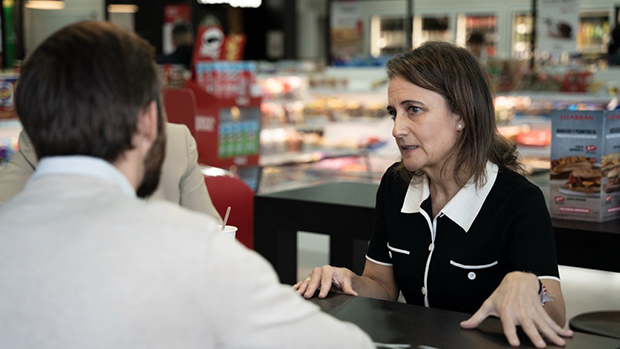
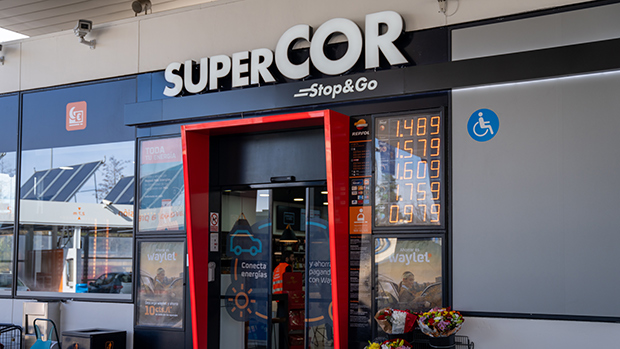
Q. There has also been a radical change inside the store, as seen in this SuperCor Stop & Go in Alfonso XIII. How has the concept of your stores evolved?
A. There were several ways to approach the convenience store challenge. You can develop your own restaurant, supermarket and coffee brands, or you can partner with existing brands. Just as we feel very comfortable on the forecourt because of our expertise, we didn't have that leadership on the convenience side. That’s where the partnership with El Corte Inglés fits in.
This collaboration has been key to our diversification strategy. SuperCor Stop & Go represents an evolution towards the proximity supermarket, combining basic products, fresh products and fast-food concepts. We currently have more than 711 stores and our goal is to reach 1,000 by 2028.
What makes this collaboration successful is the synergy between our knowledge of the forecourt world and El Corte Inglés' experience in the retail sector.
Q. Regarding the food and beverage offering, where did you set the focus?
A. The quality of our offer has increased massively. Coffee has become a key product, establishing strong partnerships with brands such as Nespresso and Starbucks. We sell more than 7 million coffees a year, which shows a strong acceptance from customers.
In addition, we have introduced quality food options such as Enrique Tomás and Lizarrán sandwiches. These products are tailored to our operational needs, with recipes that combine speed and quality. This has transformed our stations into meeting points where customers can refuel and enjoy a good meal. After six months of testing with Lizarrán, we found hot sandwiches were the most successful concepts, rather than healthy snacks or desserts. Today, the loin and cheese sandwich is the best-selling product. The preparation needs to be perfect so the customer gets the expected quality time after time.
Q. Are there regional variations in your gastronomic offer?
A. Our menu is currently standard across the country but we notice differences depending on location and time of the day. For example, the most popular products in urban stations tend to be fast and light, such as hot dogs or cold Spanish ham sandwiches, especially for breakfast. However, on highway stations customers tend to prefer more complete options, such as hot sandwiches from Lizarrán.
Q. In this station, we see a decent bar offer. Is this common in other models?
A. This model seeks to offer a more spacious and cozy space, as you can see here, where customers can have breakfast or even work while enjoying a good coffee. This includes Wi-Fi access and comfortable seating areas. We believe this approach helps to build loyalty and generate more repeat visits.
Q. In relation to last-mile services, parcel delivery has become a major part of your business.
A. Last-mile has drastically changed our operation. We have installed over 1,000 lockers for the collection and return of parcels, in collaboration with partners such as Amazon and InPost. This has been a success due to ease of access, nearby parking and 24-hour availability. Volume has also grown enormously: we handle more than 4 million parcels a year. And last year, we also worked with Amazon to introduce parcel returns at the stations.
Q. What other services are you offering to differentiate yourselves?
A. This is the first station where we have incorporated an electricity and gas contracting station. This service allows customers to resolve doubts, manage bills and contract energy services in a personal and direct environment. We want to reach more electricity and gas customers, and the best connection point is the service station. We also use it to explain our multi-energy offer: customers can get discounts of up to 20 cents per liter when they use Waylet.
I really like the concept of “Gas station as city”, because you put services that were in the city into the station, and “City as gas station”, because the recharging is now outside of stations: at home, in the street, and at shopping malls, for example. The challenge will be to have an offer that manages to generate traffic.
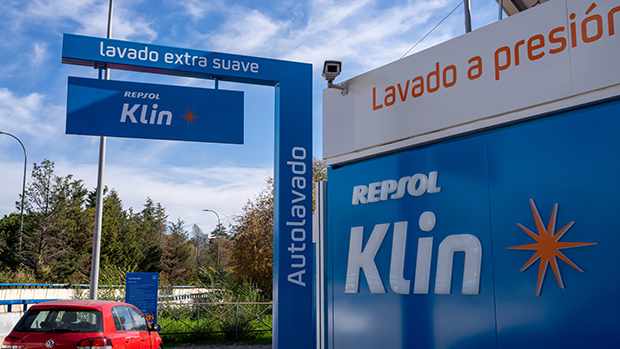
Q. In July you unified your car wash offer under the Klin brand. You also launched the first Spanish subscription model for this sector.
A. The main challenge was to modernize a service that had not changed in 20 years. Before, customers had to use tokens, coins and do the whole process manually. We wanted to transform that experience, so we decided to completely digitize it. Through Waylet, customers can now scan a QR code and activate any washing equipment.
We have connected around 2,600 machines in 400 stations and standardized the wash programs. This has required an investment of €12 million over the past two years, but has enabled us to create a homogeneous network that offers a consistent experience.
Once a standardized network was achieved, we launched a subscription service at €7.95 per month. Since the launch on July 4, the uptake has been excellent and the number of subscribers continues to grow every day. Washing is a fundamental pillar of our business. Although the capex is high, the margins are very attractive and it represents a great opportunity for us.
Written by Oscar Smith Diamante

By Oscar Smith Diamante